


Ibanez SR300EDXCZM SR Series Basse électrique 4 cordes RH - Cosmic Blue Frozen Matte
Délais estimé avant expédition à confirmer une fois la commande placée.
 Interest FREE financing available at checkout
Retour 30 jours

Livraison rapide et sécurisée

Conseils d'experts, service humain

Garantie du plus bas prix
Caractéristiques
- type de manche : SR45pc Manche en érable/noyer
- haut/dos/corps : corps Nyatoh
- Touche : touche JatobaIncrustation de points blancs
- frette : frettes moyennes
- nombre de frettes : 24
- chevalet : chevalet Accu-cast B500
- espacement des cordes : 19 mm
- micro manche : micro manche PowerSpan Dual CoilPassif
- micro chevalet : micro chevalet PowerSpan Dual CoilPassif
- égaliseur : EQ 3 bandes Ibanez Custom Electronics avec interrupteur Power Tap à 3 voies
- réglage d'usine : 1G,2D,3A,4E
- cordes : D'Addario® EXL165
- calibre des cordes : .045/.065/.085/.105
- couleur du matériel : Or
Specifications
Neck
- Scale: 864mm/34"
- Width: 38mm at NUT
- Width: 62mm at 24F
- Thickness: 19.5mm at 1F
- Thickness: 21.5mm at 12F
- Radius: 305mmR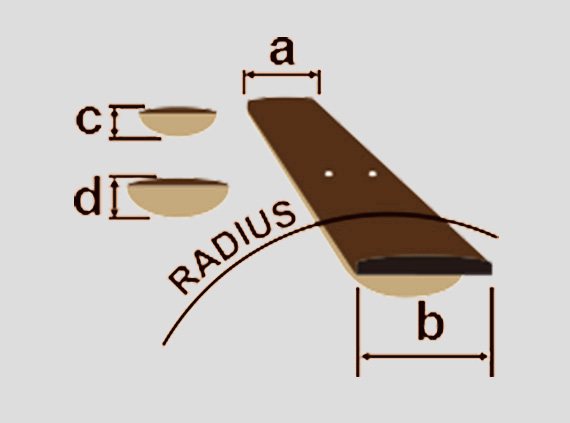
- Guitar Neck Diagram
a: Width of the neck at the nut
b: Width of the neck at the fret position specified by the neck dimension
c: Thickness of the neck at the first fret
d: Thickness of the neck at the fret position specified by the neck dimension
Radius: Radius of the fingerboar
Controls
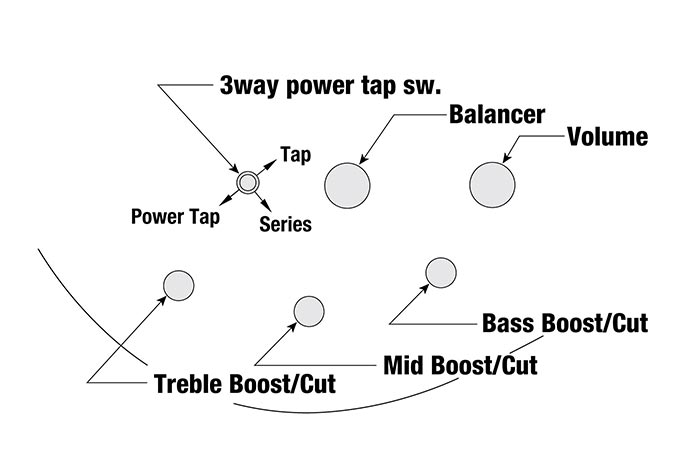
With the bass held in the playing position, there are three small knobs closest to the lower edge of the body. Directionally, from the lower bout towards the neck knobs are treble boost/cut, mid boost/cut, and bass boost/cut. There are two larger knobs above these, closer to the bridge. The knob closest to the neck controls volume, and the knob next to it is the pickup balancer control. There is a 3-way power tap switch next to the balancer knob. When the switch is in neck position, the humbuckers are tapped. When the switch is in center position, the humbuckers are in series. when the switch is in bridge position, the humbuckers are in power tap mode, which is tapped with additional low end added.
Frequency Response
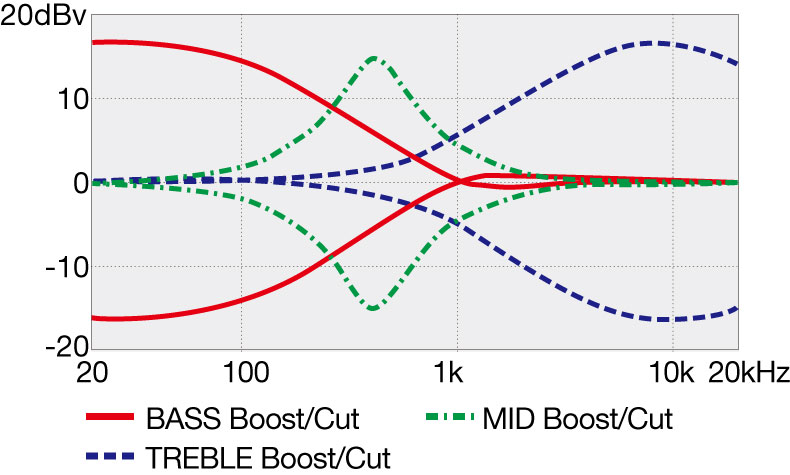
The bass boost/cut frequency curve has a peak at 20 Hz, the variable width becomes smaller toward the high range, and the variable width becomes zero at about 1000 Hz. The variable range becomes slightly larger in the high range than around 1000 Hz, but it becomes zero again near 5000 Hz. The variable range of the peak frequency is approximately ±15 dB. The treble boost/cut frequency curve draws a mountain-shaped curve with a peak at around 10,000 Hz and zero variable range around 100 Hz. The variable range of the peak frequency is approximately ±15 dB. The mid-boost/cut frequency curve creates a bell-shaped curve with a peak around 450 Hz, and the variable width becomes zero near 20 Hz and around 10,000 Hz. The variable range of the peak frequency is approximately ±15 dB.